Vendor Value Management: governing value, not vendors.
Vendor Value Management (VVM) is the management discipline for the continuous governance and management of business value from IT vendor relationships. It exists to answer one question that no existing function owns: is this relationship still justified?
What is Vendor Value Management?
Organizations spend over $600 billion a year on outsourced IT services, and most cannot confidently answer a basic question: are we actually getting the value we are paying for? Not for lack of contracts, SLAs, or governance forums — but because no existing discipline is explicitly accountable for governing vendor value across the full lifecycle of the relationship.
Vendor Value Management (VVM) is that discipline. It defines value as the net, intentional benefit expected from a vendor relationship, relative to its cost, its risk, and the viable alternatives — assessed continuously, not at renewal time. Value in VVM has four properties: it is intentional, relative, contextual, and temporal.
That distinction is the whole point. Vendor management, procurement, contract management, and service management each govern a vendor from their own angle — performance, compliance, price, tickets. Each optimizes its own KPIs. None of them is accountable for whether the relationship as a whole still earns its place. VVM adds that missing layer: value governance decides whether a relationship is worth its cost and risk; value management makes sure the evidence exists, day to day, to make that decision credible.
The operational value formula
VVM makes value computable rather than assumed: Outcomes achieved + Options created − Total lifecycle cost − Risk exposure. The difference between the value a contract promised (contracted value) and the value the organization actually receives (realized value) is value leakage — and it accumulates even while every SLA dashboard is green. VVM calls that the watermelon effect: green on the outside, red inside.
The VVM Value Leakage Model
Leakage is not one problem. VVM classifies it into three categories, each with its own diagnostic indicators, so an organization can see not just that value is being lost but where and why.
Strategic leakage
Unclear accountabilities, no named owner of the value question, loss of improvement focus, relationships that drift into the purely transactional. The intent behind the relationship is never restated, so it can never be tested.
Structural leakage
Overpayment built into the commercial model, unchecked consumption, license and capacity overruns, and no holistic view of performance across contracts. The governance was never designed to own value, so it doesn’t.
Execution leakage
Scope creep, unclaimed service credits, tickets closed before they are resolved, on-hold abuse, contract change requests that don’t match the contract. Day-to-day behaviour quietly erodes what was contracted.
The Four Axioms of Vendor Value Management
The non-negotiables of the VVM Manifesto. If a governance model violates any of these, it is observing value, not governing it.
Governance exists to decide, not observe.
A forum that produces reports instead of decisions is governance theater. The decision is the unit of governance.
Renewal is a governance decision, not administration.
Every renewal is a fresh continue / restructure / exit decision, made on evidence — not an auto-extension processed by procurement.
Assumed value cannot be governed.
If value has not been made explicit, baselined, and measured, there is nothing to govern — only spend to approve.
A relationship that cannot be safely exited is not properly governed.
Exit-readiness is the proof that the organization, not the vendor, holds the decision.
The five-stage VVM Lifecycle
VVM governs value from before a vendor is selected through to evidence-based renewal or exit. Each stage has defined decisions, evidence, and accountable roles — a RACI by lifecycle stage.
Strategy & Value Commitment
State the intended value before sourcing begins. Name the Value Owner.
Sourcing & Selection
Select against the value commitment, not just price and capability.
Contracting, Transition & Baseline
Translate intended value into contracted value. Baseline what “realized” will be measured against.
Delivery, Performance & Realization
Measure realized value continuously. Detect and classify leakage as it happens.
Renewal, Expansion & Exit
Decide continue / restructure / exit on evidence. Renewal is a decision, never a default.
Two roles make the discipline operable
The Value Owner is a business role, accountable for the continue / restructure / exit decision — without it the discipline is inoperable. The Value Manager operates the framework and ensures decision-readiness: the evidence, the baselines, the leakage findings, and the options. Proportional governance and vendor tiering keep the effort matched to what is at stake.
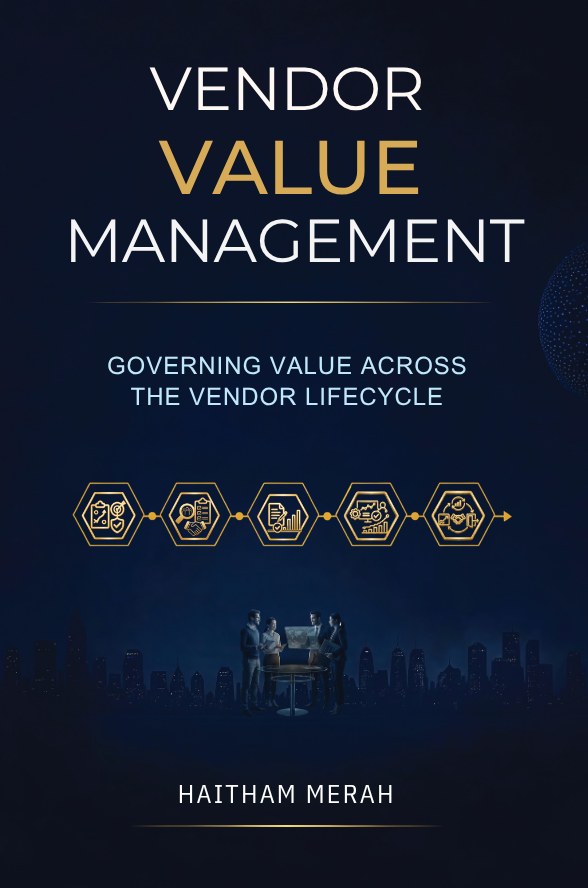
Vendor Value Management: Governing Value Across the Vendor Lifecycle
The discipline-founding book by Haitham Merah. It gives VVM its definition, its Value Leakage Model, its five-stage lifecycle, its Agile Governance decision architecture, and its Manifesto — four Axioms, eight Canon statements, and the practitioner profile that separates genuine governance from sophisticated imitation.
Every diagnostic claim is substantiated by independently verified audit findings — ArriveCAN (Auditor General of Canada, 2024), Phoenix Pay (Auditor General of Canada, 2018), the NHS National Programme for IT (UK National Audit Office, 2011), and Healthcare.gov (US Government Accountability Office, 2013). Different jurisdictions, sectors, and decades; the same structural finding.
Written for CIOs, CPOs, CFOs, IT governance leaders, Vendor Management Office directors, procurement managers, service delivery practitioners, and the consultants who serve them.
From discipline to software: how ValuFy applies VVM
The book defines what must be governed. ValuFy produces the evidence to govern it.
ValuFy is the Vendor Value Management platform: it analyzes the incident, contract, and time-tracking data an organization already holds and continuously detects and quantifies value leakage — SLA misses without credit, on-hold abuse, contract change violations, duplicated effort, wasted vendor time, and license overruns — in dollars a CFO can trace back to the underlying records. That is the Value Manager’s job, automated, so that the Value Owner arrives at every renewal decision with evidence instead of assumption.
Vendor Value Management — frequently asked questions
What is Vendor Value Management (VVM)?
Vendor Value Management is a management discipline for the continuous governance and management of business value from vendor relationships. It answers one governing question — is this relationship still justified? — by making value explicit, assigning it a named owner, and connecting it to the decisions made across the vendor lifecycle.
How is Vendor Value Management different from vendor management?
Vendor management governs vendors: contracts, performance, compliance, and relationships. Vendor Value Management governs and manages value: whether the net benefit a relationship delivers still justifies its cost and risk relative to alternatives. Vendors are governed; value is governed and managed.
What is value leakage?
Value leakage is the gap between contracted value and realized value. It accumulates even when SLAs and dashboards are green. VVM classifies it as Strategic leakage (intent), Structural leakage (design), and Execution leakage (behaviour).
Who is the Vendor Value Management book for?
CIOs, CPOs, CFOs, IT governance leaders, Vendor Management Office directors, procurement managers, service delivery practitioners, and the management consultants who serve them. It is a discipline-founding book for experienced professionals accountable for vendor relationships and their outcomes.
Where can I buy the Vendor Value Management book?
Vendor Value Management: Governing Value Across the Vendor Lifecycle by Haitham Merah is available on Amazon in paperback and Kindle (ISBN 978-1067722807).